
Team Studio Flux
Collaboration contact
After we divided the roles for each group member, we made a contract that contains the rules and things all of us need to take in consideration. This mostly comes down to communication; no matter what happens, its all good if you let your group members know what’s going on.
Each group member must be present at school no later than 9:00 AM on Monday, Wednesday and
Thursday and no later than 9:30 AM on Tuesday and Friday. The Monday, Wednesday and Thursday
are mandatory due to mandatory presence.
If a member cannot be on time or will be absent for any reason, they must communicate this to the
group via the WhatsApp group. Failure to do so will result in a warning.
Tasks and responsibilities will be fairly divided based on each member’s skills and strengths. All work
produced by the group will be discussed collectively, and feedback will be provided.
Andrejs Dvoskins – Developer
Lucas Dernison – Designer, team lead
Brian van den Hoogenhof – Designer, Developer
Sem Schneider – User Researcher
Cicilia Pham – Strategist

Reflection on Collaboration Contract: Looking back, the collaboration contract helped set clear expectations early on, especially around communication and attendance. In practice, most of us stuck to these agreements, and the WhatsApp group made quick updates easy. However, we didn’t always hold each other accountable when someone broke a rule, like being late without notice. In future projects, we could improve by revisiting the contract midway through the project to reflect and adjust if needed. Speaking for myself my communication was always spot on. Even if i was 5 minutes late I let the group know and gave them a clear reasoning for it, I think I handled my communication very Professionaly this semester.
Planning
For the project we made a planning on Microsoft teams that keeps everyone updated on what each person is doing. The ability to give a task a deadline is also very helpful and gives insight on what is important to do and when it should be done.
During the first week and after work is done tasks are defined and team members have their deadlines on their own work which is discussed with group and with teachers, and then it goes to "completed tasks" section under "Awaiting feedback" column.
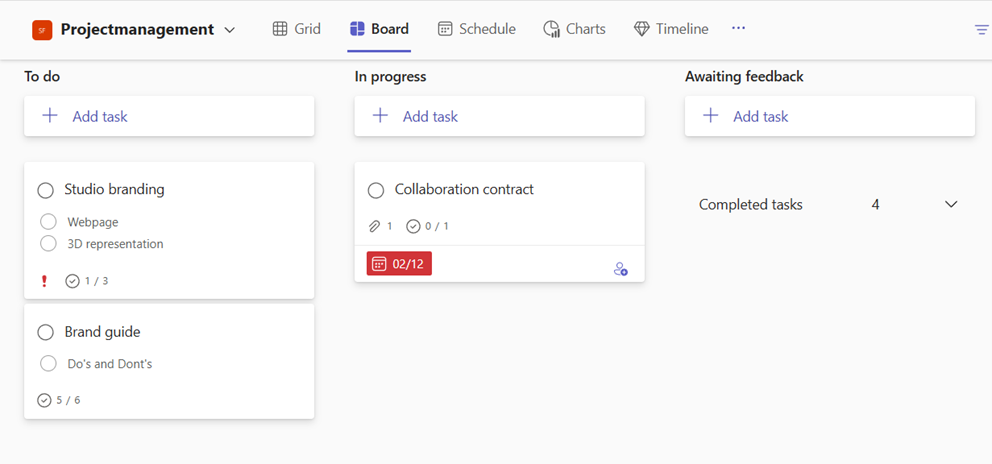
Reflection: looking back at this planning we made, I noticed that we really didn't use it enough. We basically just made plans while everyone was there but not really keep it up in the Teams planner. This may have lead to some tasks getting pushed back further so that is definitely something we as a group can improve on.
Communication in the group
We mainly use WhatsApp for our communication. This is used every day to keep each other updated if anyone is late or sick, or if we change the time we are meeting that day.
Group files and images are also sent in there but if it is important or a bigger file we use Teams

Client interaction group Project
For the group project we chose Fontys minor marketing about Virtual Production. This choice was made based on our strengths and preferences, and this was our first pick out of all the presentations we had for all the options. After getting the thumbs up on the Marketing for the minor Virtual Production we sent the Client a message to ask if we can meet them and ask them questions about what they expect us to make.
This was a really good meeting, and we got a lot of clarification on what we can do. This conversation was also recorded so that we can listen to it afterwards if needed again. (We asked if that was okay with the client, and they said yes :)


She also sent some more information afterwards that she couldn’t answer at that moment the interview took place, so this is a very good sign of healthy communication.
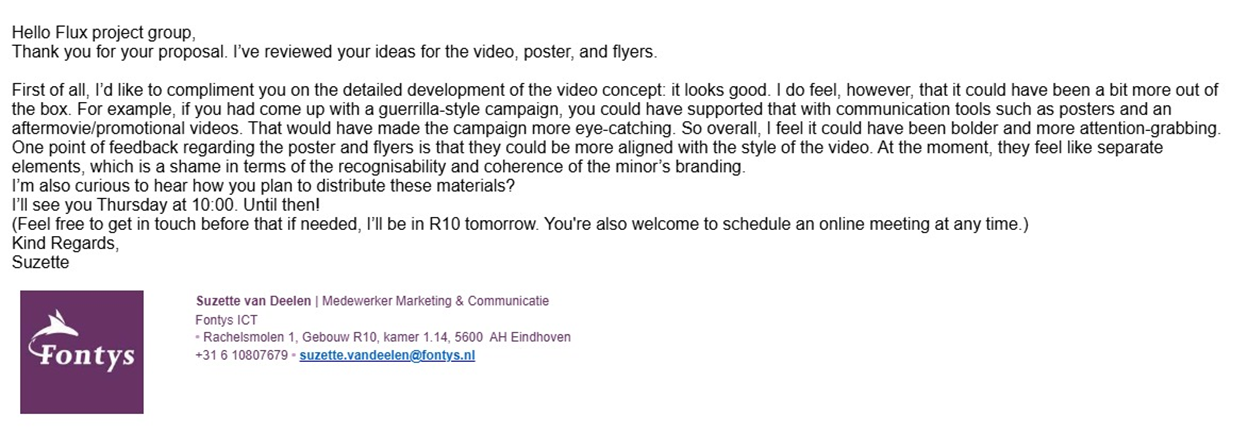
We have been working on the project for a few more weeks now and we have new insights, feedback and comments from the stakeholders that I’d like to mention. We had a presentation day on the 15th of may where we presented our project so far to the stakeholders and different teachers. This are the key feedback points we got from it and things we will be doing in the next few weeks.
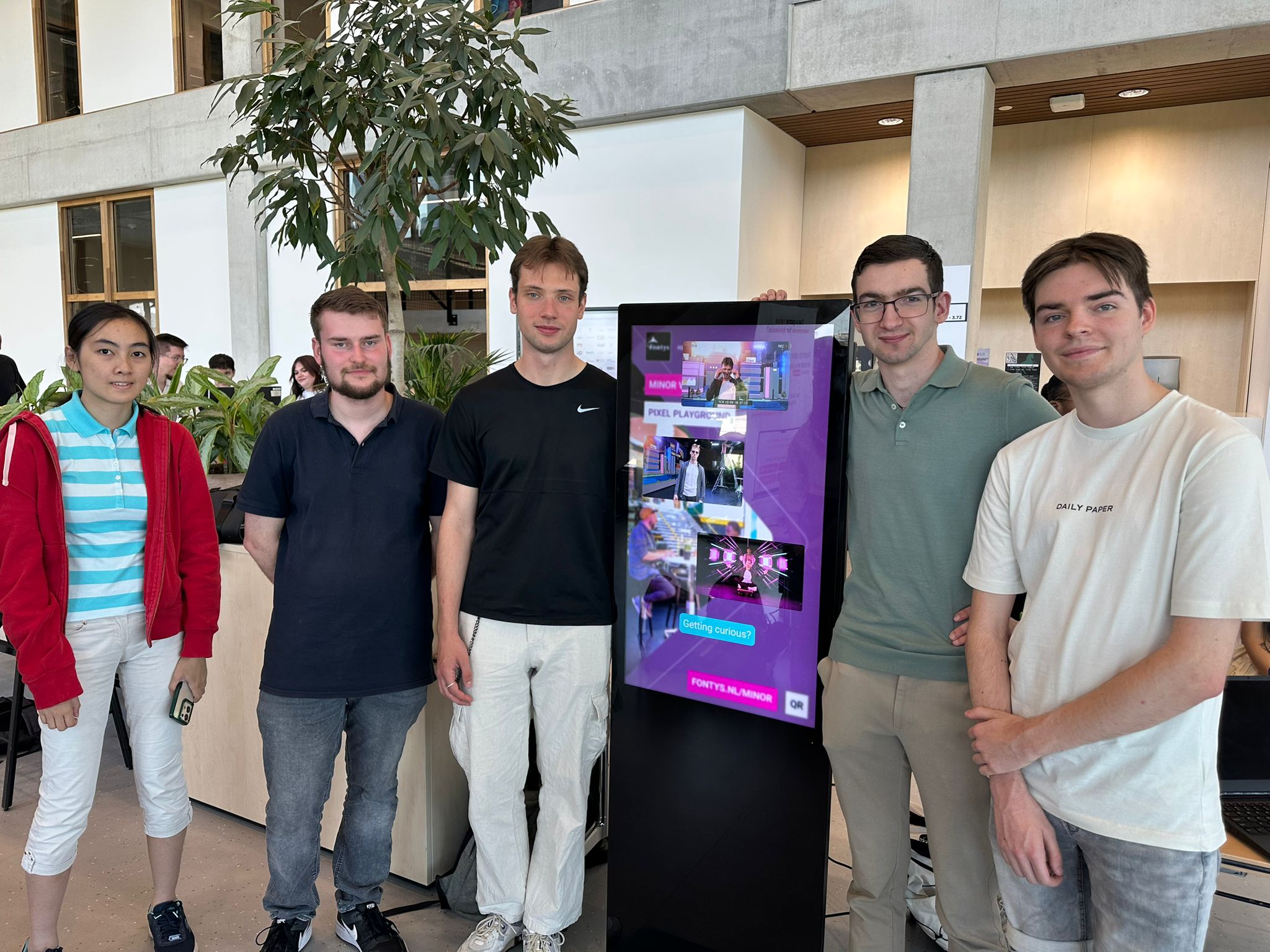
We had our final presentations and our client was there too. She really loved our digital interactive poster where we can show videos and information on! she took a picture of us with the screen and she told us that they will use our interactive poster for the marketing! Mission succes!
We gave her advice on how to use it best, on what aspect ratios the videos can be played, and how to install the web app on multiple screens like the one we used.
Reflection: this was a very fun project and the client was also very nice. I believe we had a very healthy relationship with the client that lead to us making a video that perfectly fit what they wanted. If I would change something than it would be the amount of times we sat down with eachother and showed the work we had done, but for the presentations we had and with them being there we just didn't feel the need to do so. But I think there isn't such a thing as planning too many meetings.
Research
Dividing research
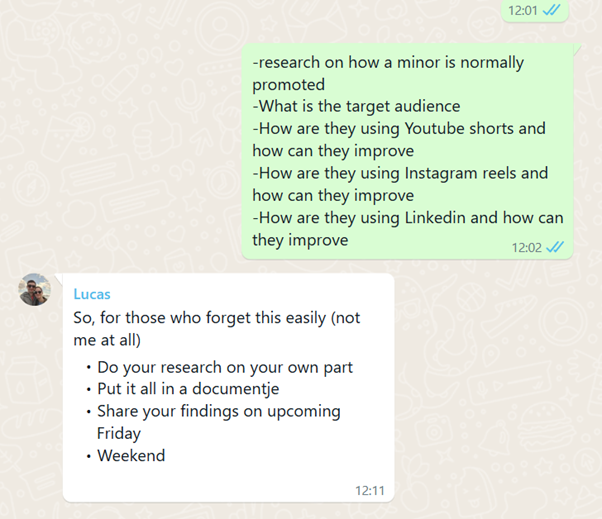
We split up multiple research tasks for each group member. We had 5 things we needed to research so that perfectly fits the amount of group members we have. The things we needed to research were this.
I got the task to do the research on how they are using Instagram so that’s what I started with 😊.
Instagram research
I analyzed the existing FontysICT Instagram account, as well as other educational and creative production accounts on Instagram (e.g., @fontysict, @creativemediacollege, and @pixar). I focused on the following aspects:
-Types of content posted
-Use of highlights, bios, thumbnails
-Engagement strategies (comments, calls-to-action)
-Visual consistency
An effective content strategy for the target audience (people who might want to pursue the minor “Virtual Production” at Fontys) should focus on providing valuable information, inspiring potential students and showcasing the benefits of pursuing this minor. Here are examples for content:
1. Informative blog posts and articles:
• Information about the Fontys Virtual Production minor that clarifies to the student exactly what this minor entails. Also, the advantages of the minor can be listed
2. Usage of students:
• Publish success stories of students that made cool things for virtual production before or have worked in Pixel Playground, these people can tell relatable stories on how they've used it and what they have done in the world of Virtual Production.
3. Webinars and workshops:
• Organize online events (also called Webinars in the business world) in which experts talk about trends and developments in the Virtual Production sector and how the education at Fontys aligns with them.
• Offer workshops that cover specific skills relevant to the target audience, such as introductions to Pixel Playground, this provides more insight on what the minor entails.
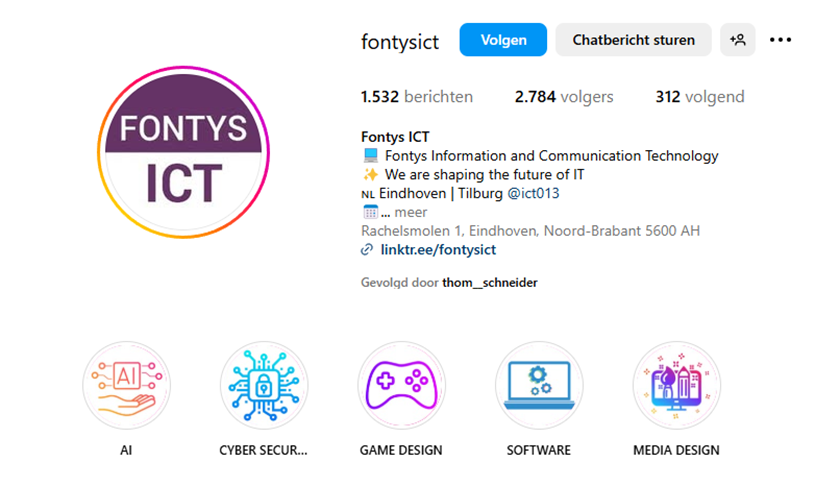
They are using the highlights correctly by using clear images and the text under it so if you are interested in that specific subject then you can just click on it and see all the posts and stories.
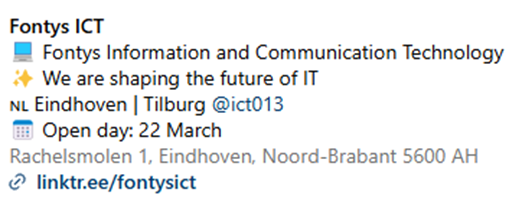
Also, the usage of the biography is correct; clear information with a linktree to all the links u need if you're interested in Fontysict. This is definitely a good platform to post video's on for the minor Visual Production.
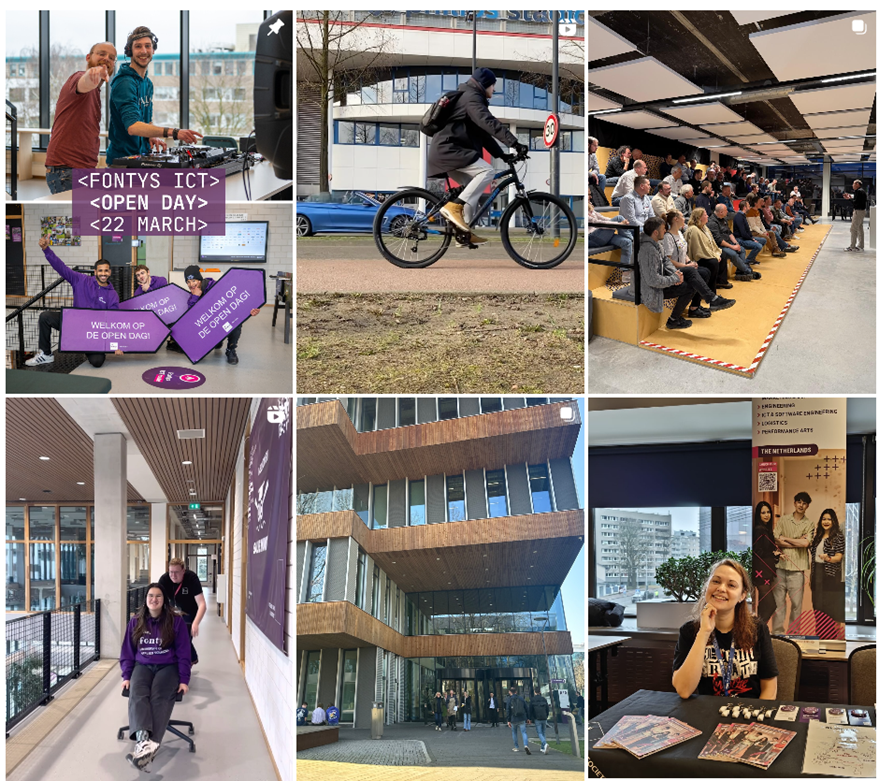
Thumbnails (the image you see before clicking on the post) are also a very important aspect of making your Instagram account professional. As you can see Fontys uses this very well with clear images and not just black screens or plain text.
How we can apply these insights:
When planning our content strategy for the Virtual Production minor, I proposed showcasing student projects and short-form educational videos.
We can use Instagram highlights for key topics like “Pixel Playground,” “Student Work,” and “Workshops.”
Based on the thumbnail insight, you can choose what frame of the video you want as the thumbnail,this creates visually engaging preview images for each post to keep the feed consistent and professional.
Reflection
Individual reflection
Looking back on this project, I recognize both the progress I made and the areas where I need to improve in terms of applying professional standards. One of the most important lessons I’ve learned is the value of actively seeking critical feedback. Throughout the process, I often asked for vague confirmations like “Is this okay?” instead of requesting focused, actionable feedback. As a result, some of my creative choices, particularly the short videos I made, lacked alignment with the tone and quality of the main promotional video. Had I tested these earlier or asked for specific input, I could have avoided this disconnect and improved the final result.
Another major shortcoming was my lack of assertiveness within the group. Although I contributed consistently to the project, I didn’t address the imbalance in group participation. I noticed that only two members, including myself, were doing most of the work, but I didn’t raise the issue. From a professional standpoint, I now realize that ignoring these problems affects not just group morale but also the quality of the final product. In future projects, I will aim to be more assertive and create space for open communication about roles and responsibilities.

On a more positive note, I’m proud of the main video we produced. It met the project requirements, communicated the concept clearly, and followed a professional workflow: we scripted, storyboarded, shot, and edited with clear goals in mind.
Overall, I feel confident about the work I delivered and the way I contributed to the team. This project helped me realize that I really enjoy making videos, so I'll definitely continue doing that!